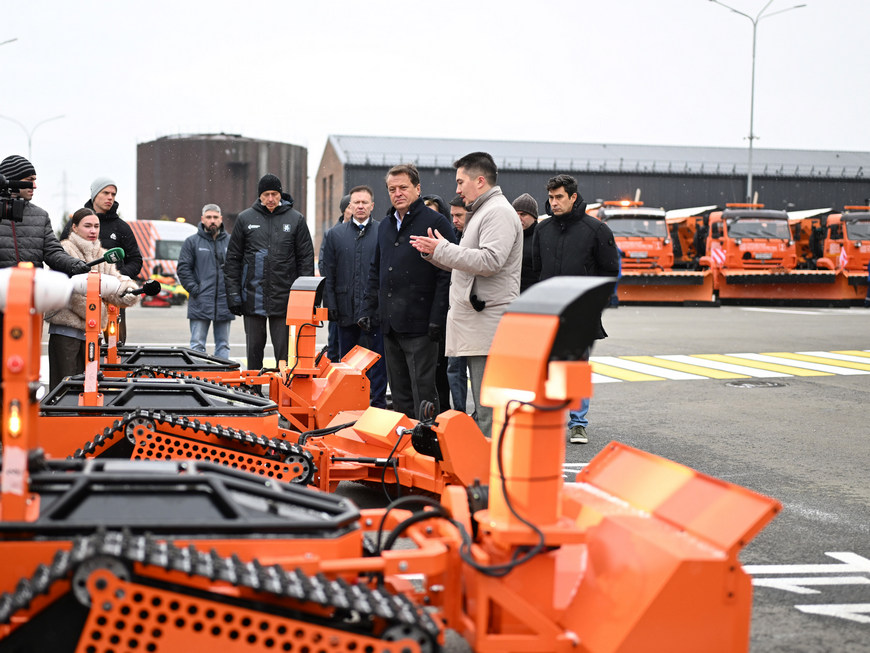
Kazan road services to get 65 street cleaning robots
read more-
Ilsur Metshin inspects the progress of work on the embankment along Lake Kaban
-
Ilsur Metshin: “We are maintaining a high pace of road repairs — this year we have resurfaced 130 km of roads”
-
Ilsur Metshin: “We are focused not only on updating the rolling stock, but also on introducing new technological solutions”
-
Ilsur Metshin: “Kazan has become a platform for discussing approaches to preserving the historical environment”
-
Ilsur Metshin on the Bakery Plant: “Caring for employees as a sign of a mature business.”
-
I.Metshin on the new building of City Hospital No. 18: “Medical care for our residents will reach a new level”
-
I.Metshin: “All scheduled road works will be completed by October 30”
-
Ilsur Metshin on the renovation of kindergarten No. 415: “It is completely renewed”
-
The Mayor of Kazan visits the new life-skills training apartment for children with special needs
-
Construction of the largest-capacity sewage pumping station in the Sovetsky district is in its final stage
-
This year, as many as 44 social institutions have been renovated in Kazan
Kazan road services to get 65 street cleaning robots
Kazan is expanding its municipal fleet with 65 remote-controlled robotic cleaners designed for areas where large machinery cannot operate, such as sidewalks, courtyards, and parks. A local manufacturer has already produced the first 50 vehicles : 10 machines have been handed over to city services. Kazan Mayor Ilsur Metshin inspected the new equipment.
“Ahead of the winter season, Kazan municipal landscaping crews have done a lot of work. We need to clear 23 million square meters of area, including over 4 million square meters of sidewalks. As our road network and the number of vehicles keep growing, the task is becoming increasingly challenging: we have to remove snow quickly. That is why we have decided to test robotic equipment to reduce manual labor,”- said Ilsur Metshin.
A Kazan-based manufacturer will supply 50 of the robots to city services. Another 15 will be provided by companies from other Russian cities. Among the suppliers are firms from Novosibirsk, Kovrov, and China.
“In total, urban maintenance companies will operate 65 of these robots, bringing the total number in Kazan to around 100 units. This equipment comes from various manufacturers, including Kazan-based firms, Siberian enterprises, and companies from the Alabuga special economic zone. We want to see which solutions work best for our courtyards, sidewalks, and hard-to-reach road sections,”- commented the Mayor.
The robots assembled in Kazan are operated remotely via a joystick, with an operator stationed next to each machine to control its movement. At this initial stage, one employee will be assigned to each unit.
The equipment features two interchangeable attachments. The first is a brush for clearing freshly fallen snow, leaves, dirt, and dust. The second is an auger-rotor module designed to throw large volumes of snow aside. In the summer, the same machines will be used for street sweeping and mowing grass, with additional attachments provided for these tasks.
“Our main goal for this equipment is to clean the sidewalks. We currently lack mechanization for this type of work. According to the suppliers' preliminary estimates, one robot can replace five to ten workers, but we are taking a more conservative figure of about five employees.Throughout the upcoming winter, we will measure their productivity and efficiency compared to manual labor. We will also gather feedback and work with manufacturers to determine what upgrades are needed,”-explained Albert Shaynurov, chairman of the Committee for External Improvement.